- VINYL
- CD
- MC
- Movies
- K-POP
- MERCH
- ACCESSORIES
- OUR PICKS
- Game Soundtrack All Media
- Rhino Limited Vinyl
- Vinyltonic
- Way Out West 2026
- Friday Releases
- 2026-07-17
- 2026-07-24
- 2026-08-07
- 2026-08-14
- 2026-08-21
- 2026-08-28
- 2026-09-04
- 2026-09-11
- 2026-09-18
- 2026-10-02
- 2026-10-09
- 2026-07-10
- 2026-07-03
- 2026-06-26
- 2026-06-19
- 2026-06-12
- 2026-06-05
- 2026-05-29
- 2026-05-15
- 2026-05-22
- 2026-05-08
- 2026-05-01
- 2026-04-24
- 2026-04-17
- 2026-04-10
- 2026-04-03
- 2026-01-16
- 2026-01-23
- 2026-01-09
- 2026-01-30
- 2026-02-06
- 2026-02-13
- 2026-02-20
- 2026-02-27
- 2026-03-06
- 2026-03-13
- 2026-03-20
- 2026-03-27
- 2025-12-19
- 2025-12-12
- 2025-12-05
- 2025-11-28
- 2025-11-21
- 2025-11-14
- 2025-11-07
- 2025-10-31
- 2025-10-24
- 2025-10-17
- 2025-10-10
- 2025-10-03
- 2025-09-26
- 2025-09-19
- 2025-09-12
- 2025-09-05
- 2025-08-29
- 2025-08-22
- 2025-08-15
- 2025-08-08
- 2025-08-01
- 2025-07-25
- 2025-07-18
- 2025-07-11
- 2025-07-04
- Metal Weekly
- Bengans Distribution
- Musicboxes
- Music Books
- 200 Albums To Own On Vinyl
- Record Store Day
- Signed
- Eurovision
- Vinyl Holder
- Rocktober
- National Album Day
- CAMPAIGNS
- Gift Card
- Customer service
- FAQ

-%
Save
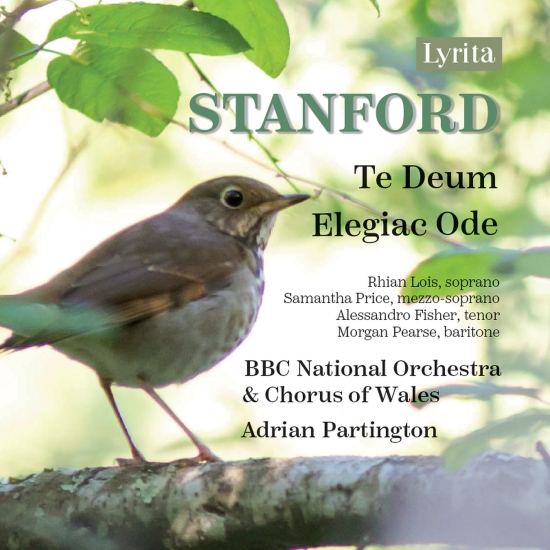
Charles Villiers Stanford - Te Deum & Elegiac Ode
CD
€15.99
Facts
By the time Stanford had received a commission from the Norfolk and Norwich Festival to write a choral work for them in 1884, he had, at the age of 32, already begun to assert himself as one of Britain's leading composers. The Elegiac Ode was, however, his first mature foray into the world of major British choral festivals. Some of the Elegiac Ode had in fact been sketched three years earlier in 1881, but after the Norwich commission was received, Stanford evidently grasped the opportunity to complete the work in it's entirety in July 1884. The words were taken from the last part of Whitman's elegy, 'When lilacs in the dooryard bloom'd', written in the aftermath of President Lincoln's assassination in 1865 (it was a text which Stanford's pupil, Holst, later used for his Ode to Death, composed in the wake of the war in 1919). Taking the seven verses of the burial hymn, Stanford divided his chosen text into four parts, thereby creating a four-movement musical structure more akin to a choral symphony with it's substantial (and thematically related) choral outer movements flanking two shorter inner essays. By the time Stanford had received a commission from the Norfolk and Norwich Festival to write a choral work for them in 1884, he had, at the age of 32, already begun to assert himself as one of Britain's leading composers. The Elegiac Ode was, however, his first mature foray into the world of major British choral festivals. Some of the Elegiac Ode had in fact been sketched three years earlier in 1881, but after the Norwich commission was received, Stanford evidently grasped the opportunity to complete the work in it's entirety in July 1884. The words were taken from the last part of Whitman's elegy, 'When lilacs in the dooryard bloom'd', written in the aftermath of President Lincoln's assassination in 1865 (it was a text which Stanford's pupil, Holst, later used for his Ode to Death, composed in the wake of the war in 1919). Taking the seven verses of the burial hymn, Stanford divided his chosen text into four parts, thereby creating a four-movement musical structure more akin to a choral symphony with it's substantial (and thematically related) choral outer movements flanking two shorter inner essays. Stanford's large-scale setting of the Te Deum Op. 66 was first sung at the Leeds Festival on 6 October 1898 and it's ambitious, opulent dimensions were clearly intended to be a fitting commemoration of the accession to the throne of Queen Victoria (it's dedicatee) sixty years earlier as well as a tribute to the full-bodied, well-trained Leeds chorus of 350 singers. A particular feature of the Te Deum is the grandeur of much of it's choral writing. Though also dramatic in it's impact, a dominating feature of the Te Deum is it's prominent use of the chorus, and the many fulsome sonorities Stanford was able to draw from the magnificent 'instrument' of the Leeds voices. © Jeremy Dibble
| Article number: | SRCD435 |
| Artist: | Charles Villiers Stanford |
| Barcode: | 5020926043528 |
| Label: | Lyrita |
| Media: | CD |
| Release date: | 2024-07-05 |
| Units in packaging: | 1 |
- 1. Te Deum In B-Flat Major[komma] Op. 66: I.
- 2. Te Deum In B-Flat Major[komma] Op. 66: Ii
- 3. Te Deum In B-Flat Major[komma] Op. 66: Ii
- 4. Te Deum In B-Flat Major[komma] Op. 66: Iv
- 5. Te Deum In B-Flat Major[komma] Op. 66: V.
- 6. Te Deum In B-Flat Major[komma] Op. 66: Vi
- 7. Elegiac Ode[komma] Op. 21: No. 1[komma] Come[komma] L
- 8. Elegiac Ode[komma] Op. 21: No. 2[komma] Dark Mo
- 9. Elegiac Ode[komma] Op. 21: No. 3[komma] From Me
- 10. Elegiac Ode[komma] Op. 21: No. 4[komma] The Nig
Tracklist
See more items
Others have bought: